
 Psychiatry and counselling, despite wanting to achieve the same ends, often have vastly different means. Psychiatry is often dominated by treatment of mental health issues through chemical methods, whilst counselling and psychotherapy find solutions through dialogue and communication, hence we often refer to it as the ‘talking cure’.
Rachel Freeth has worked cross-discipline, and has made it her mission to find a way to humanise the clinical nature of psychiatry. She raises awareness of the benefits counselling and psychotherapy can bring, and the harm psychiatry can cause. At the heart of that is the importance of relationship and listening.
She’s tackling this topic in an event on 16th April in Brighton – Psychiatric Diagnosis – What Might This Mean for Your Client and for You? – she’ll be offering an understanding of psychiatric diagnosis, and how this interplays with a client’s mental health and counselling.
This interview serves as an introduction to the topic and Rachel’s work.
Rachel Freeth interview
How did you start out in counselling & psychotherapy?
The human psyche has always interested me. Then having experienced the transformative power of being listened to, particularly in my late teens and early twenties which were very dark times for me, it was probably inevitable that I would train as a counsellor, which I then did in the late 1990s.
I understand that you first trained as a doctor and currently work part-time as a psychiatrist. What drew you to psychiatry and, conversely, what drew you away from it by making the decision to train as a counsellor?
Yes, I trained as a doctor first, fairly quickly deciding that I would then specialise in psychiatry.
There were a number of reasons why I was drawn to psychiatry. I realised at medical school that I had developed a sensitivity towards people experiencing mental and emotional suffering. I therefore felt that this was an area of Medicine in which I probably had the most to offer.
Psychiatry, whilst informed by science, is also, in my view, very much an art and is deeply enriched by the humanities. I was therefore drawn to its holistic potential. However, I think that this potential is unfulfilled (wasted even) and modern day psychiatry has become narrow and wedded to a mechanistic form of science more interested in drug treatments than exploring meaning. This left me feeling very disappointed and ill at ease with it. I have also found it enormously hard in my role as a psychiatrist to listen to people in the way that I would like to (also a reflection of the culture and economics of healthcare services), hence I separately pursued counselling training.
How does working as both a psychiatrist and a counsellor fit together? What are the key lessons from psychiatry that have informed your counselling practice?
I made a specific decision to train as a counsellor in the person-centred tradition, as I feel most drawn to humanistic and existential ideas, and the theory and philosophy of Carl Rogers. This means, therefore, that in many ways I live rather a double professional life. My two roles are so very different and I don’t think I could really say they complement each other.
That said, I think they can enrich each other and I am always looking for the possibilities of dialogue. My psychiatry experience means that I feel relatively comfortable working as a counsellor with people experiencing more severe forms of mental and emotional distress, which is not to deny the challenges also. In addition, I know that many people have not been helped by the psychiatric system, and even damaged by it because they have not felt listened to or understood. I think this motivates me as a counsellor to counter forms of alienation, isolation and stigma that mental suffering can bring.
My experience as a psychiatrist has also given me a sensitivity to the destructive effects of powerlessness and power imbalances, and this particularly informs the way I practice as a counsellor.
You have written a book called Humanising Psychiatry and Mental Healthcare, and have written for the BACP journal In Therapy. What is your main message or philosophy that you want to get across to your audience about psychiatry and mental healthcare?
I think what motivates me in what I write is an awareness of the flaws and limitations of mental healthcare as it is currently organised within our society, the potential for harm psychiatry can do, and the need for a quality of listening and relationship that is so frequently lacking.
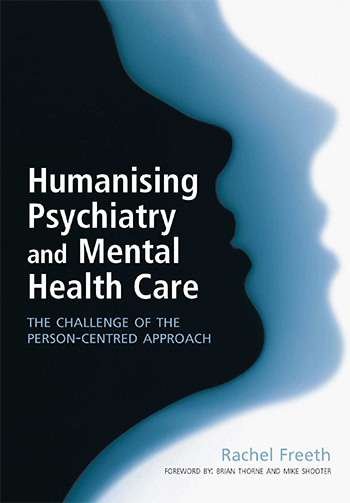
Humanising Psychiatry and Mental Health Care.
The book was trying to make the case for a form of mental healthcare informed by person-centred (Rogerian) values, whilst also exploring the challenges and difficulties of this theoretically, philosophically and in practice. To an audience of counsellors, my main message would be that the mental health system needs to be transformed by humanistic values, a much greater sensitivity to power dynamics, and skilled and sensitive listening. That is what is desperately needed – forms of counselling that can offer this (although many counsellors and psychotherapists will already know this). I want to empower counsellors and affirm what we offer, and not be intimidated by psychiatric ‘experts’ or other mental health professionals who are ill-informed about what counselling is and what it has to offer. Of course, this is a message that also needs to be heard by politicians.
What got you interested in delivering training?
I think what motivates me in training is what motivates me in writing – a desire to communicate and share ideas, and a hunger to learn.
Psychiatry and mental health is a conceptually complex subject, and full of controversy. I find it endlessly challenging and interesting to find ways of communicating in a way that makes people question their own thinking and assumptions. I like to encourage people to question and sit with their questions, rather than seek certainties and occupy fixed positions… I also need to offer the same encouragement to myself!
With my two roles I think I am in a good position to develop bridges of understanding between psychiatry and counselling and explore what each has to offer the other.
If you weren’t a therapist (or psychiatrist), what would you be and why?
Actually there are many things I would consider. Some of my other interests include history, sport and music. I think I would most want to be a professional musician, maybe a singer in a choir, although that was never on the cards. Happily, I can indulge those interests in my spare time.
Where can people hear more from you? (eg, your own Blog, Website, Twitter, Email?)
My website says a bit more about me from which people can also contact me. NaturalIy, I also invite people to attend my workshops!
Latest Courses

Working with Disordered Eating & Eating Disorders
Explore the emotional and psychological roots of disordered eating and gain essential therapeutic skills to help clients develop a healthier relationship with food, with Prof. Julia Buckroyd. Friday 2nd October…

Healing Traumatic Memory: Essential Skills
This workshop takes a healing-centred, non-narrative approach to trauma, drawing on Somatic Experiencing, EMDR, and IFS to support affect regulation and help clients restore safety and wholeness. With Tracy Jarvis.…

Transference and Countertransference
Unlock the hidden power of transference and countertransference and discover how these fascinating unconscious dynamics can transform your clinical work, with Victoria Settle. Friday 6th November 2026. Online CPD Training…
Get 20% off your first workshop
Join the BTP mailing list and receive a 20% discount code for your first booking — plus early access to new events, blogs & articles, CPD resources, and insights from our expert trainers, straight to your inbox. No spam. Unsubscribe any time.
Therapy Education Online
ThEO is part of Brighton Therapy Partnership
Many of Brighton Therapy Partnership's live events are uploaded to our online library, Therapy Education Online (ThEO).
Therapy Education Online brings the very best of counselling and psychotherapy training to a global audience.
See the full library of training courses through the link below.
Get 20% off your first workshop
Join the BTP mailing list and receive a 20% discount code for your first booking — plus early access to new events, blogs & articles, CPD resources, and insights from our expert trainers, straight to your inbox. No spam. Unsubscribe any time.
Therapy Education Online
ThEO is part of Brighton Therapy Partnership
Many of Brighton Therapy Partnership's live events are uploaded to our online library, Therapy Education Online (ThEO).
Therapy Education Online brings the very best of counselling and psychotherapy training to a global audience.
See the full library of training courses through the link below.
Before submitting, please take note of our community guidelines.