
Erotic transference and countertransference is a complex and completely normal part of therapy. This article takes a look at 9 key points for therapists working with erotic transference.
To learn more about this topic, you can watch our online CPD workshop: Love in Psychotherapy. Watch the trailer below.
1. What is erotic transference and countertransference?
Erotic transference is a term used to describe the feelings of love and the fantasies of a sexual or sensual nature that a client experiences about their therapist. Erotic countertransference is about the therapist’s feelings about their client.
2. When did erotic transference and countertransference become part of psychotherapy?
Erotic transference and countertransference have been around since the beginning of psychotherapy itself as seen in the case of Anna O, arguably the first psychotherapy patient and the person who coined the phrase ‘talking cure’, and her therapist Joseph Breuer (Freud’s mentor). Anna O was infatuated with Breuer, even having a phantom pregnancy with what she believed to be his child.
Breuer was also enthralled by his patient, and went home every day to tell his wife about her. Increasingly Mrs Breuer became upset, jealous and depressed at her husband’s growing fascination with Anna. On realising this Breuer abruptly ended the therapy with Anna and the following day took his wife away on a second honeymoon. He never again practised ‘the talking cure’.
3. Erotic transference and countertransference in In Treatment
The issue of the erotic transference and countertransference and the dilemmas it raises within the therapeutic dyad are played out brilliantly in the first series of HBO’s TV drama In Treatment with Gabriel Byrne as the psychotherapist Dr Paul Weston.
His first patient of the series, at 9am on Monday morning, is Laura who asks: “Am I the first patient to be in love with you Paul?”. He replies: “I am not an option”, but still ends up in Laura’s bedroom and it destroys his marriage. You can see a clip of how the transference/countertransference plays out between Laura and Paul on You Tube.
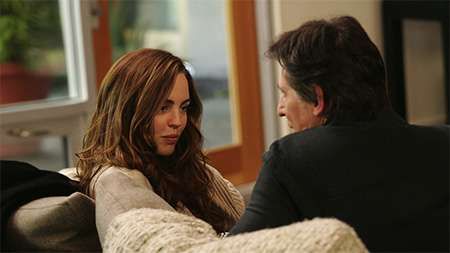
Transference is played out in In Treatment between Paul and Laura (Copyright HBO)
4. The problem of love
The most common presenting issue in therapy is the problem of love. If we consider issues such as fear, anxiety, abuse, neglect, abandonment and bereavement (the list goes on), we are essentially talking about a problem about love.
5. Eroticism is present in everyone
We all have an erotic fantasy life, whether we are sexually active or not. And we all have an erotic history: we have all learnt how to relate to ourselves and others in erotic, sensual, and sexual ways. Really there is no escaping the effects of Eros in our life!

“We all have an erotic fantasy life, whether we are sexually active or not. And we all have an erotic history: we have all learnt how to relate to ourselves and others in erotic, sensual, and sexual ways.”
6. Erotic transference and countertransference are common
Feelings of “love” within the counselling and therapy relationship, either from the client’s side or the therapist’s side, are not a bad thing; some would argue they are inevitable given the emotionally intimate nature of therapy. For example, a survey in 2006 found that 90% of psychotherapists reported being sexually attracted to a client on at least one occasion. Working through these feelings can help the client understand and accept their own relationship with love and desire and what was missing for them in their early life that they are seeking to compensate for in the present.
7. It is the therapist’s duty to respond appropriately
The main problem with erotic transference/countertransference in therapy is the therapist’s level of ability to appropriately address and contain these issues and feelings for their client, or when the therapist chooses to act upon the feelings they experience for the client. However, it is the client’s privilege to act out their feelings for their therapist; it is the therapist’s responsibility to do the opposite.
8. Managing erotic transference
There are three main ways to manage erotic transference/countertransference within a therapeutic relationship.
The first way is to not deal with it at all. This is probably what most of us therapists do; we simply just don’t address the issue because we’re not too sure how to go about it. An extreme example of this is Joseph Breuer who ran a mile (literally) when it became clear that there were feelings of “love” within his therapy with Anna O.
The second way to manage the erotic “love” within the therapeutic relationship is to act on it; that is, to have a sexual relationship with your client. This method is clearly not recommended; it is the responsibility of the therapist to maintain appropriate boundaries within the therapy work. An example of a therapist who didn’t manage this is Carl Jung who slept with two of his patients.
The third way is, of course, to talk about it. This is the ‘talking cure’ after all.
9. There are lots of helpful books and articles available if you want to deepen your knowledge about erotic transference and countertransference
Here are a few recommendations:
Desire and the Female Therapist: Engendered Gazes in Psychotherapy and Art Therapy (Routledge, 1995), by Joy Schaverien
Psychotherapy: An Erotic Relationship (Routledge, 1997), by David Mann
Gender, Countertransference and the Erotic Transference: Perspectives from Analytical Psychology and Psychoanalysis (Routledge, 2006), edited by Joy Schaverien
The ‘frame’ as a container for the erotic transference – A case study, by Catherine Rouholamin (Psychodynamic Practice, May 2007, Vol. 13, 2, pp. 167-182)
The Erotic Transference: Dream or Delusion?, by Franco De Masi (Journal of the American Psychoanalytic Association, December 2012, Vol. 60, 6, pp. 1199-1220)
To have our latest events, along with counselling and psychotherapy related news, such as advice, training, and interviews with leading professionals in the field emailed straight to your inbox just enter your email address to the right and hit ‘subscribe’. Also, consider following us on Twitter and Facebook.
To learn more about this topic, you can watch our online CPD workshop: Love in Psychotherapy. Watch the trailer below.
Latest Courses

Transference and Countertransference
Unlock the hidden power of transference and countertransference and discover how these fascinating unconscious dynamics can transform your clinical work, with Victoria Settle. Friday 6th November 2026. Online CPD Training…

Intrusive Thoughts: A Treatment Guide
Deepen your understanding and therapeutic approach to intrusive thoughts across OCD, anxiety and trauma, transforming your confidence and clinical skills in supporting clients. Saturday 28th November 2026. ONLINE CPD Training…
Understanding & Working with Addiction in Therapy
Reframe everything you thought you knew about addiction and unlock a powerful relational approach to transform your therapeutic work, with Sarah Pennock. Saturday 6th February 2027. Online CPD Training for…
Get 20% off your first workshop
Join the BTP mailing list and receive a 20% discount code for your first booking — plus early access to new events, blogs & articles, CPD resources, and insights from our expert trainers, straight to your inbox. No spam. Unsubscribe any time.
Therapy Education Online
ThEO is part of Brighton Therapy Partnership
Many of Brighton Therapy Partnership's live events are uploaded to our online library, Therapy Education Online (ThEO).
Therapy Education Online brings the very best of counselling and psychotherapy training to a global audience.
See the full library of training courses through the link below.
Get 20% off your first workshop
Join the BTP mailing list and receive a 20% discount code for your first booking — plus early access to new events, blogs & articles, CPD resources, and insights from our expert trainers, straight to your inbox. No spam. Unsubscribe any time.
Therapy Education Online
ThEO is part of Brighton Therapy Partnership
Many of Brighton Therapy Partnership's live events are uploaded to our online library, Therapy Education Online (ThEO).
Therapy Education Online brings the very best of counselling and psychotherapy training to a global audience.
See the full library of training courses through the link below.
2 Comments
Leave a Comment
Before submitting, please take note of our community guidelines.
I am interested in the training on working with children if narcissists and mother daughter relationship
You can find out more about our current workshops by going to the event tab on the home page of this website, and all our workshops are listed there. The Mother/Daughter workshop with Tori Settle is taking place in June 2025.